
Global food systems: production, impact and challenges
Food is not just about what each person buys or what each country produces. We live in a deeply interconnected world, where food, ingredients, technologies, policies and even environmental crises circulate between countries and continents. To truly understand the origins of food and make informed choices, it is essential to understand how global food systems work.
This subsection builds on the foundations laid at ages 12–14, but now takes a more critical approach, integrating science, the environment, economics and food geopolitics.
A food system is the set of processes required to feed a population. It includes crop and livestock production, fishing and aquaculture, food processing, transport and storage, distribution and trade, consumption, waste and residue management, as well as the public policies, legislation and economic factors that influence all these stages.
When we look at how these processes are organised and interconnected across all countries, we refer to the global food system. It is a complex web linking Portuguese farmers to Asian markets, bananas from Mozambique to European supermarkets, and wheat from Canada to Portuguese bakeries. Every food item that reaches our plates forms part of this global network of production, distribution and consumption.
Food globalisation has grown for several reasons:
a) Climate and geography
Not all countries are able to produce all types of food efficiently. Portugal, for example, does not have a climate suitable for growing cocoa, coffee or bananas all year round.
b) Seasonality
When it is not the season for tomatoes, cucumbers or strawberries in one country, they are imported from another where it still is.
c) Specialisation
Some countries have become specialists in certain products:
- Norway: fish
- Brazil: soy
- Spain: vegetables
- India: spices
d) Constant demand
Consumers have become accustomed to having everything available all year round, even foods that used to be seasonal.

Globalisation fosters diversity and trade, but it also presents significant challenges.
a) Emissions and the carbon footprint
International transport – lorries, ships and aeroplanes – increases CO₂ emissions.
b) Loss of food sovereignty (a country’s ability to decide how it produces and secures its own food supply)
When a country relies too heavily on imports, it becomes vulnerable to:
- conflicts
- pandemics
- price fluctuations
- droughts in other countries
c) Inequality
Some regions produce a great deal for export, but are unable to feed their local populations.
d) Loss of biodiversity
Global production tends to favour just a few species:
- wheat
- rice
- maize
- soya
Of 30,000 edible plants, just four provide almost 60 per cent of the world’s calories.
e) Climate vulnerability
Droughts, heatwaves, floods and pests affect global production and cause price rises.
Science shows that, to ensure human health and environmental sustainability, we need food systems that differ from the current ones: more resilient, capable of responding to crises; more diversified, avoiding dependence on a small number of crops or products; with a smaller ecological footprint, using fewer resources and emitting fewer greenhouse gases; fairer, in terms of access and working conditions; and which respect planetary boundaries, that is, what the Earth can sustain without suffering ecological collapse.
There are several possible paths towards this transformation. Regenerative agriculture, for example, seeks to restore soils, increase biodiversity and improve water retention capacity, rather than simply extracting resources. Strengthening robust local and regional food systems helps to reduce dependence on long supply chains and shorten the distance between producer and consumer.
Another important pillar is increasing the consumption of plant-based foods, such as vegetables, fruit, pulses, whole grains and nuts, which generally have a lower environmental impact than many animal-based products. Reducing food waste is equally essential: around a third of the food produced worldwide is wasted, and reducing this figure is one of the most effective ways of making the system more sustainable.
Finally, public policies play a decisive role: clear labelling, incentives for sustainable production, support for responsible agricultural practices and regulation of ultra-processed foods can steer both supply and demand towards a healthier and fairer food system.

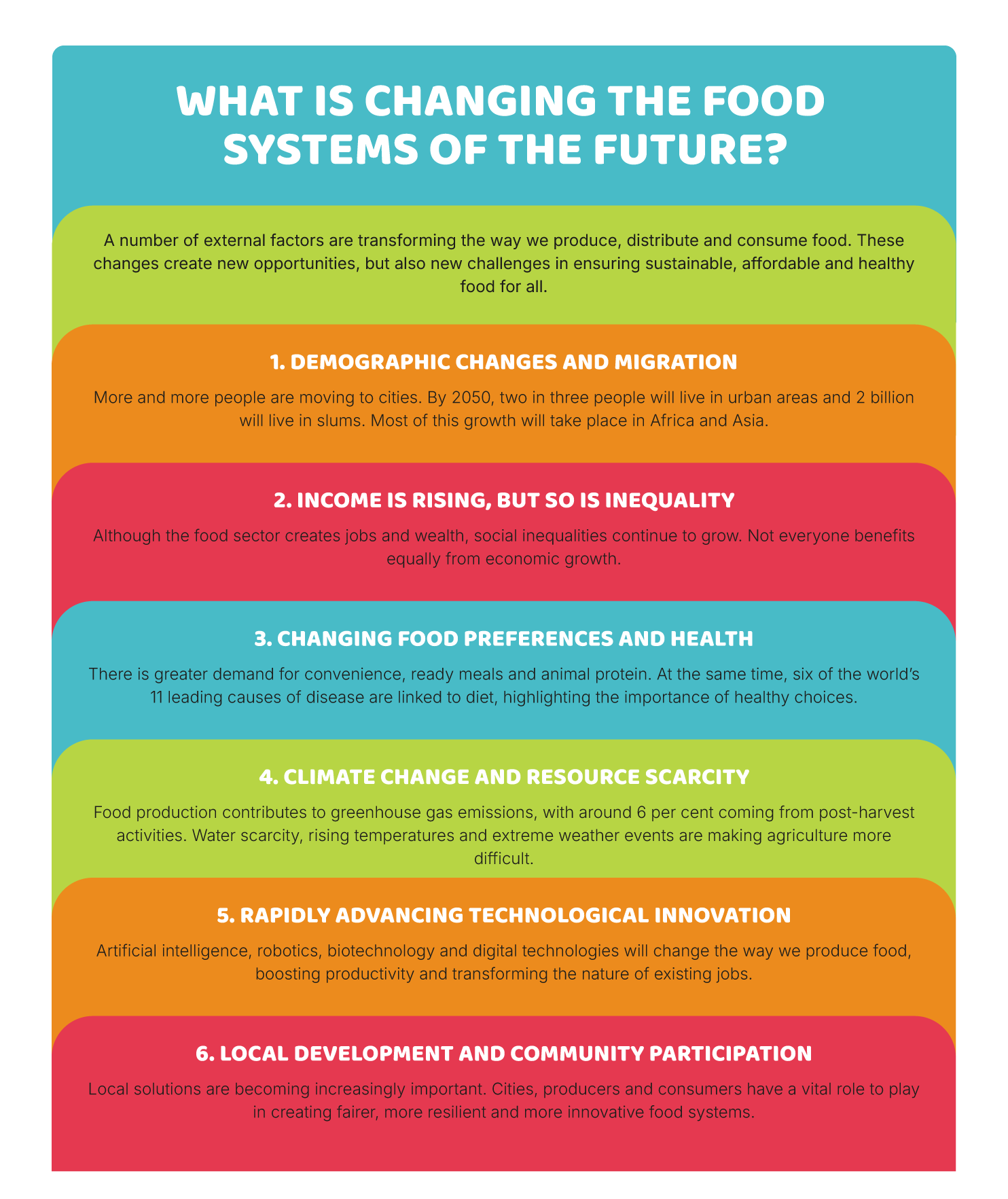
Global decisions have an impact on what’s on your plate:
- if the price of wheat rises: the price of bread, pasta and cereals goes up;
- if there is a drought on the Iberian Peninsula: fewer vegetables available;
- if fuel prices rise: transport becomes more expensive, and food prices go up;
- if a country bans exports (as happened with rice in India): global impact on prices.
The global food system is a delicate network.
Your role in the global food system
Even though you’re a young consumer, you have a real impact. You can:
- choose seasonal and locally sourced food wherever possible;
- reduce consumption of ultra-processed foods;
- to give preference to producers who respect the environment;
- add some variety to your meal;
- reduce waste;
- share accurate information;
- to promote foods that adhere to Mediterranean principles.
What you eat is a daily act with a global impact.

When comparing two similar foods (for example, apples or tomatoes), check the following:
1. Country of origin
2. Time of year
3. Type of farming (organic, conventional, integrated)
Often, the ‘best choice’ is the one that combines proximity, seasonality and the lowest environmental impact.
FOODWISELab challenge

Understand how your food choices link your plate to the whole world, by assessing origin, seasonality, production methods and distance travelled, and by reflecting on ways to reduce your environmental footprint.