
Critical analysis of food labels and nutritional claims
Food labels have three main functions:
- to provide information about the food or drink
- to set the product apart from others on the market
- to provide information that enables consumers to decide whether the product is safe to eat
- Critical Reading of labels and nutritional claims
When you choose a food product at the supermarket, you’re interpreting information, even without realising it. Between the ages of 12 and 14, you learnt the basics of reading labels; now that you have greater independence and critical thinking skills, it’s time to go deeper: how do you read a label as an informed consumer? - And, more importantly: how can we distinguish science from marketing?
Although it may seem as though your choices are entirely personal, what you find on the shelf has already been filtered by factors such as price, convenience, advertising and what is most profitable to sell. Eating habits are strongly influenced by the availability of food where you live and study, by the relative cost of the options and by the way they are presented. Reading labels carefully is a way of regaining control: instead of choosing solely on the basis of appearance or brand, you start to choose based on the information provided.
A label can help you make good choices… or it can mislead you if you don’t know how to analyse what lies behind appealing claims such as ‘high in fibre’, ‘zero sugar’, ‘natural’ or ‘protein+’.Let’s break down the label, piece by piece.
List of ingredients: the true identity of the food
The list of ingredients is where the truth begins. The ingredients are listed in descending order of quantity.
What you should look out for:
a) The smaller, the better
Foods with short ingredient lists tend to be less processed. E.g.:
- “peanuts + salt”: a good sign
- “modified starch + glucose + flavourings + colourings + stabilisers + vegetable fat + salt…”: typical of ultra-processed (UP) foods
b) Hidden sugars
Sugar may appear under names such as:
- glucose-fructose syrup
- maltodextrin
- dextrose
- invert sugar
- honey, agave, coconut (which is still sugar)
If it appears in the top 3 of the list: high content.
c) Poor-quality fats
Avoid refined vegetable oils and hydrogenated fats. Choose olive oil as your added fat.
d) Additives
The presence of additives is not necessarily a bad thing; the question is what they are used for and how many there are. Many ultra-processed foods use cosmetic additives to mimic the flavour, texture and colour of real food.
Nutritional table: making sense of the figures
It’s not enough just to look at the calories. The nutrition table shows:
- energy
- fats (total and saturated)
- carbohydrates (total and sugars)
- fibre
- protein
- salt
Warning signs
- sugars >10 g per portion (even in ‘health-conscious’ products)
- will >1 g/100 g
- high levels of saturated fat in snacks or pastries
- low fibre content in products that should contain it (e.g. ‘wholemeal’ cereals)
Smart comparison
ALWAYS choose per 100 g (or 100 ml), never per portion, because portions can be manipulated for marketing purposes.
Nutritional claims: between science and marketing
Nutritional claims are statements such as:
- “high in fibre”
- “light”
- “low-fat”
- “source of protein”
These phrases are regulated by law, but they do not mean that the food is healthy.
Much food advertising exploits precisely these claims to highlight a positive aspect and divert attention from the rest of the ingredients. Many campaigns focus on just one word – ‘protein’, ‘fit’, ‘gluten-free’ or ‘natural’ – to create an automatic association with health, even when the product is still high in sugar, salt or fat. Knowing this helps you to take a more critical look: first, check the list of ingredients and the nutrition facts table; only then should you decide whether the claim actually makes sense.
Choices don’t happen in a ‘vacuum’ either: family, friends, social media, influencers and repeated advertising shape preferences and expectations. If everyone around you is consuming certain snacks or drinks, those products are more likely to seem like the ‘normal’ choice. Developing critical thinking means precisely stepping off autopilot: comparing ingredients, the nutrition facts table and frequency of consumption, and working out whether what is commonplace around you is, in fact, a good option.
Examples:
- “0% fat”: it may contain a lot of sugar
- “high in protein”: may be ultra-processed
- “light”: this simply means a 30% reduction in a particular nutrient compared with the original version.
- compared with the original version
A positive claim does not make up for poor-quality food.
Alegações de saúde: o limite entre o permitido e o duvidoso
As alegações de saúde vão mais longe:
- “contribui para o normal funcionamento do sistema imunitário”
- “ajuda a reduzir o colesterol”
Estas só podem ser usadas se aprovadas pela EFSA (Agência Europeia de Segurança Alimentar).
No entanto:
- muitas alegações são verdadeiras, mas irrelevantes
- outras são usadas em produtos de fraca qualidade nutricional
Ex.: “rico em vitamina C” num rebuçado industrial.
Making sustainable choices isn’t just a matter of willpower: what you can choose also depends on your budget, the time you have available for cooking, and the options available at your school, in your neighbourhood or at your workplace. The aim isn’t perfection, but to do the best you can within your own circumstances. Whenever you have a choice between several similar options, opting for less processed foods with simple ingredient lists, produced closer to home and with less packaging, already makes a difference to your health and the planet.
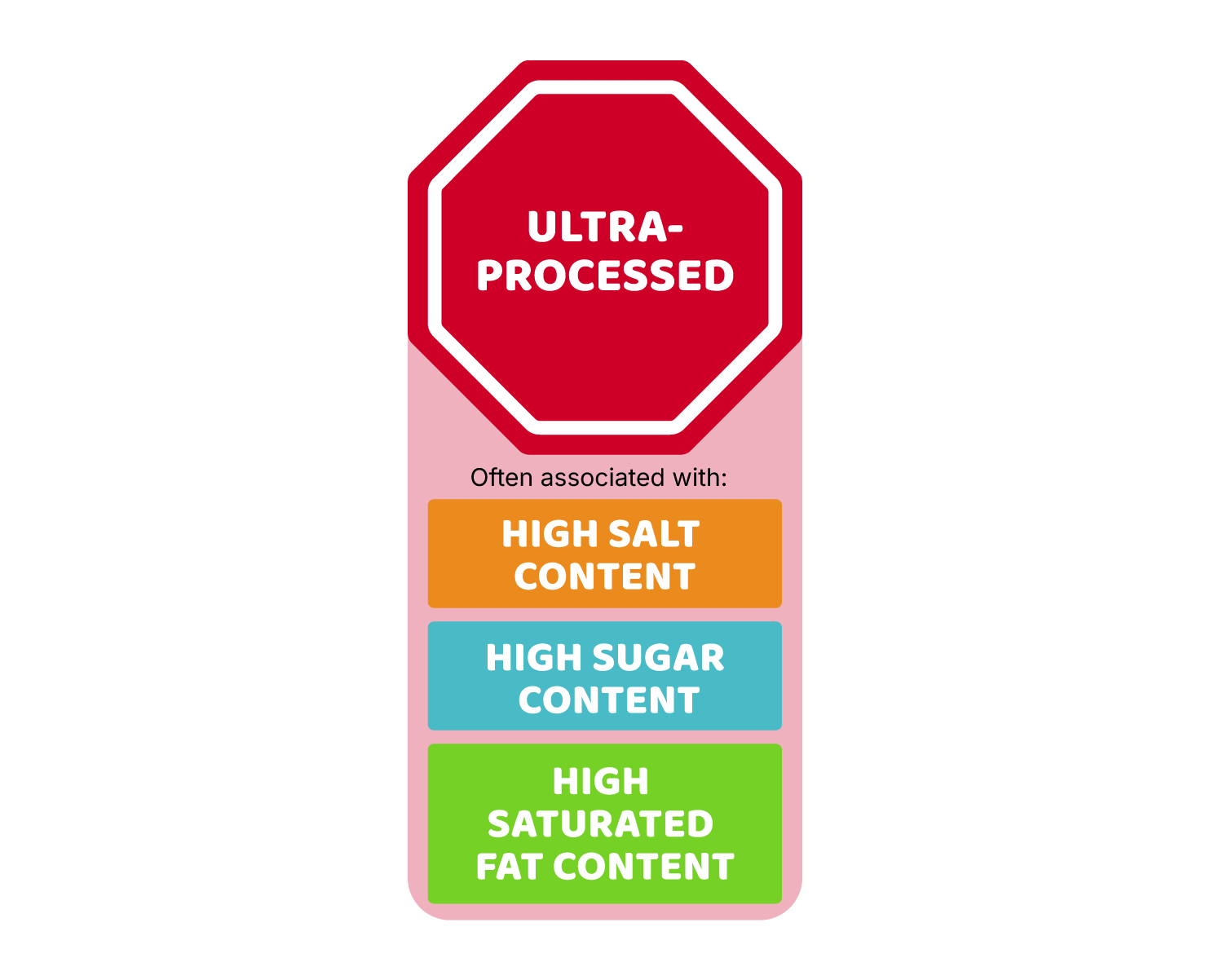
The NOVA classification identifies ultra-processed foods as industrial formulations containing ingredients that we do not use at home.
Signs of ultra-processed food:
- long list of ingredients
- sweeteners, colourings, flavour enhancers
- refined flours + fats + sugar combined
- exaggerated claims (“protein+”, “zero guilt”, “power energy”)
Ultra-processed foods are associated with:
- increased risk of obesity
- metabolic disorders
- depression (emerging evidence)
- microbiota imbalance
- hyper palatability: eating without actually being hungry
The final verdict: the whole > the parts
A label should never be read ‘in isolation’. The choice should take into account:
- ingredients
- nutritional quality
- type of processing
- origin
- environmental impact
- consistency with the Mediterranean diet
If food needs lots of slogans to make it sound healthy… it probably isn’t.
The role of teenagers: autonomy and critical literacy
If you’re aged 15–17, you’re already able to:
- interpreting figures
- compare products
- identify marketing strategies
- inform the family of the choices made
- avoid visual pitfalls
- recognise healthy patterns independently
Choosing food is an act of informed autonomy.

The 10-second rule:
Before you put a product in your trolley, read the first three ingredients. If they’re sugar, refined fat or highly processed flours… put it back on the shelf. It works surprisingly well.
FOODWISELab challenge

To develop the ability to read labels critically, distinguishing marketing from actual nutritional quality, and to understand how claims can influence (or mislead) choices.