
Olive oil processing
Olive oil is produced by extracting oil from olives, the fruit of the olive tree. It is a natural product and an essential part of the Mediterranean diet, highly prized for its flavour, nutritional value and health benefits.
Olive harvesting
Olives are usually harvested between autumn and winter, when they reach their ideal stage of ripeness.
Harvesting can be done by hand (using nets and poles) or mechanically (by shaking the trees).
After harvesting, the olives are transported quickly to the press to prevent enzymatic and microbial degradation and loss of quality.
Cleaning and crushing
At the mill, the olives are washed to remove leaves, twigs and impurities.
They are then crushed (or ground) together with their stones, forming a homogeneous paste containing olive oil, freeseed water and solid parts of the fruit.
Beating (malaxation)
The resulting paste is slowly beaten for 20 to 40 minutes, in a process known as malaxation.
This step allows the drops of olive oil to come together, enabling the drops to coalesce and facilitating extraction.
The temperature must be controlled by keeping the process temperature below 27 °C; the olive oil can then be labelled as “cold-pressed”.
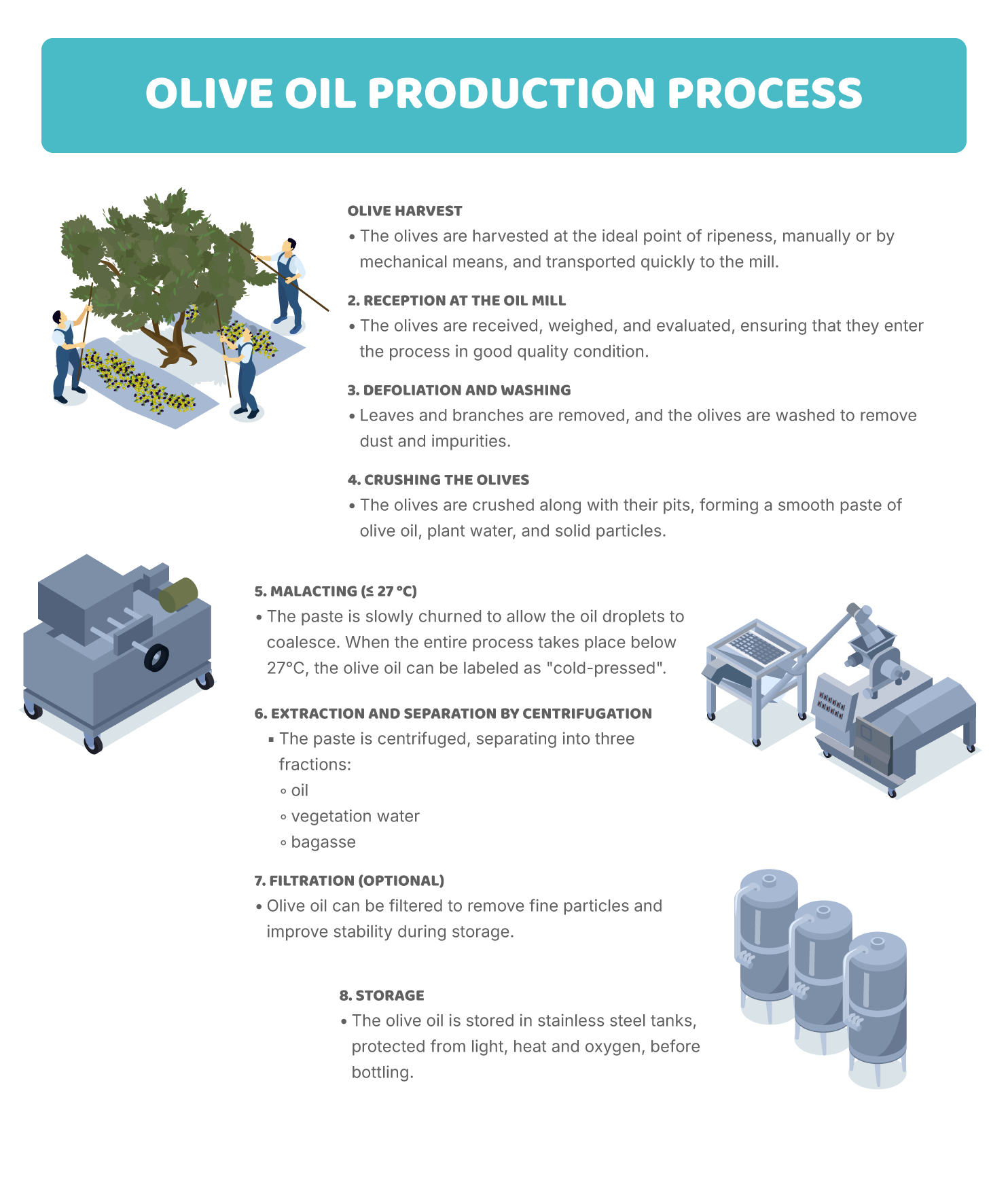
The paste is then placed in a centrifugation system, which separates the olive oil from the millrun and the solid residues.
In the past, presses were used, but today this process is mechanical and more hygienic, better preserving the antioxidants and phenolic compounds in the olive oil.
The olive oil obtained at this stage is classified as virgin olive oil or extra virgin olive oil, depending on acidity criteria and sensory evaluation.
Filtering and storage
The olive oil is filtered to remove small particles and then stored in stainless steel tanks, protected from light and heat, to preserve its flavour and nutrients.
Finally, it is bottled in dark glass or metal cans, which help to preserve its properties.
By-products and utilisation
During processing, waste products such as pulp (solid fraction) and wastewater are produced.
Nothing is wasted:
- Pomace can be used to produce energy, fertilisers or pomace oil, which is obtained through industrial processes different from those used for virgin olive oil;
- Wastewater can be treated and reused in agriculture;
- The leaves and branches are shredded to make organic compost.
These practices make the process more sustainable and environmentally friendly.
SUSTAINABILITY AND INNOVATION
Modern olive mills use less water and energy, and employ two-stage systems, which significantly reduce the production of liquid effluent.
The energy required is often obtained from dry pomace, which reduces the carbon footprint.
In addition, research is underway to reuse antioxidant compounds from olive oil wastewater, which are used in cosmetics and natural supplements.

A tip for planning your meals
Use Portuguese extra virgin olive oil as your main cooking and seasoning oil.
One to two tablespoons a day are enough to reap the benefits of its properties.
Choose locally produced and sustainably sourced olive oils, and store them in a cool place away from light; this will preserve the flavour and support environmentally friendly farming.
FOODWISELAB challenge

To understand how olive oil is produced from olives, distinguishing between simple mechanical processes and more intensive processes, and to realise why olive oil is the main fat in the Mediterranean diet.
From olive to olive oil: How is olive oil produced?