
Plan Health
What Does Eating Well Mean for Our Health and the Planet?
Good planning is the first step towards ensuring that your choices have a positive impact not only on your health, but also on the planet.
When you choose what to eat, you’re also deciding how you treat the planet, who produces your food, and the traditions that give meaning to your meals. A sustainable diet looks after both you and the environment: it prioritises seasonal and local produce, reduces waste, protects biodiversity and cuts down on the consumption of ultra-processed foods. The Mediterranean Diet, which we promote at FOODWISELab, is an excellent example: it promotes lifelong health and has a smaller environmental footprint. Learning to eat well means understanding how food shapes your body, your community and the ecosystems on which we depend. And planning starts with understanding what it means to eat well.
Ready to find out?
What does it mean to eat well?
Eating well means choosing foods that provide your body with the energy and nutrients it needs to grow, concentrate in class, play sport and stay healthy. It goes beyond simply distinguishing between ‘healthy’ and ‘unhealthy’; it’s about knowing how to plan, choose, prepare and eat sensibly.
And when it comes to planning, it means understanding how to organise your meals in a balanced way, choosing food combinations that give you energy throughout the day, making the most of seasonal ingredients and avoiding waste. Good planning helps you to enjoy variety on your plate, save time and money, and ensure that your choices look after both you and the planet.
What You Eat Makes All the Difference
A balanced diet during your teenage years supports your growth and gives you energy and a sense of well-being. Your daily choices affect your bones, your heart, your performance and your sleep.
The Mediterranean diet is a sensible way to nourish the body. It is not just about individual foods; it is a way of eating that combines flavour, tradition and science. Some studies suggest that teenagers who follow this dietary pattern may enjoy better cardiovascular health, stronger bones, fewer signs of inflammation, and improved physical fitness and mental wellbeing.
So, how does that play out in your day-to-day life?

|
Fish and Seafood
|
Eat fish three times a week, preferably oily fish (sardines or salmon).
1 portion = 100–125 g (the size of your palm). Good for the heart and brain.

|
Eggs
|
Up to 3 portions per week. One portion = 1 egg. High-quality protein that supports optimal muscle growth and maintenance.

|
Dairy Porducts
|
3–4 portions a day of milk, yoghurt or cheese. 1 portion = 1 glass/30 g. Calcium and protein are good for your bones and teeth.

|
Wholemeal Cereals
|
1–2 portions per meal. Choose wholegrain options: bread, rice, pasta and oats. Portion size: 1 slice or 3 tablespoons. Provides energy and aids digestion.

|
Fruit and Vegetables
|
5 portions a day: 2 portions of vegetables and 3 portions of fruit. 1 portion = 1 medium-sized piece or 1 cup raw/½ cup cooked. Energy, fibre and vitamins.

|
Pulses (beans, chickpeas, lentils)
|
Include 3 times a week. 1 portion = ½ cup, cooked. Pulses: a source of plant-based protein and fibre; filling and sustainable.

|
Nuts
|
Eat 1 small handful (30–45 g) a day. Unsalted nuts, such as walnuts and almonds. They give you energy and healthy fats.

|
Extra Virgin Olive Oil
|
Use it every day for cooking or seasoning. 1 portion = 1 tablespoon (10–15 mL). It’s good for your heart and brain, and adds flavour.

|
Water
|
Stay hydrated: Girls aged 14 and over: 2 L/day; Boys aged 14 and over: 2.5 L/day.
Opt for plain water; avoid sugary drinks.

|
Red Meat
|
Limit to 2 portions per week. 1 portion = 100 g cooked. Excessive consumption may be harmful to your health and the environment.

|
Processed Meat
|
No more than 1 portion per week. 1 portion = 2 slices of ham or 1 small sausage (50–70 g). Limit your intake of salt and additives!

|
Potatoes
|
Limit to 3 portions per week (100 g per portion). Choose boiled or baked potatoes; avoid chips and ultra-processed versions.
Food and Health
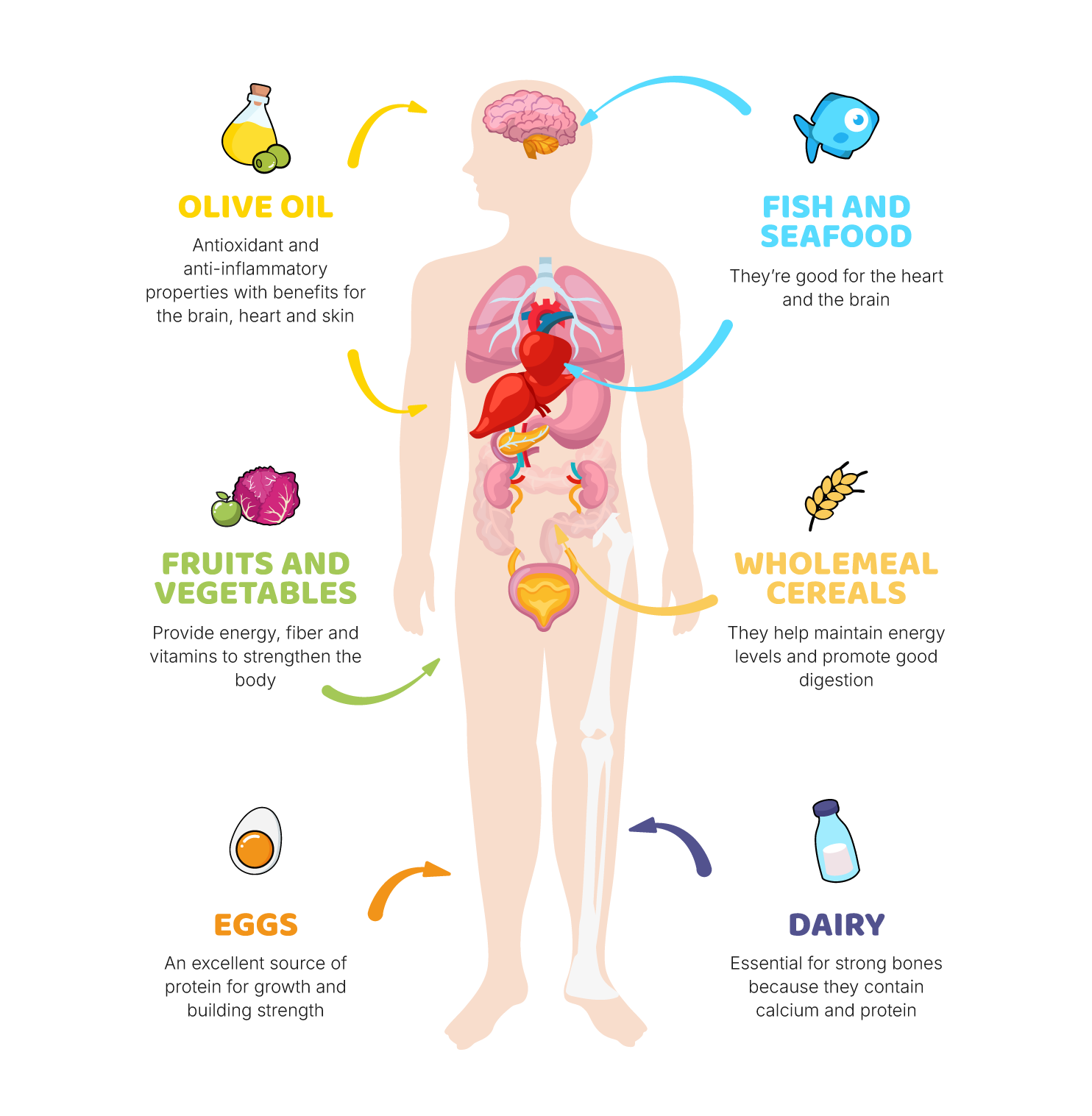
This diagram shows how different food groups contribute to the health of the body’s organs and systems. Based on the principles of the Mediterranean diet, it highlights the specific benefits of each group, ranging from essential energy and nutrients to protection for the heart, brain and bones.
FOODWISE Daily Guide: How Much Should I Eat?
This table sets out daily and weekly recommendations for different food groups, based on the principles of the Mediterranean diet.
It includes examples of portion sizes to help you gauge how much to put on your plate and explains the importance of each food group for your health.
You can download it and stick it somewhere visible, such as the fridge, to remind yourself to make balanced and varied choices throughout the week.
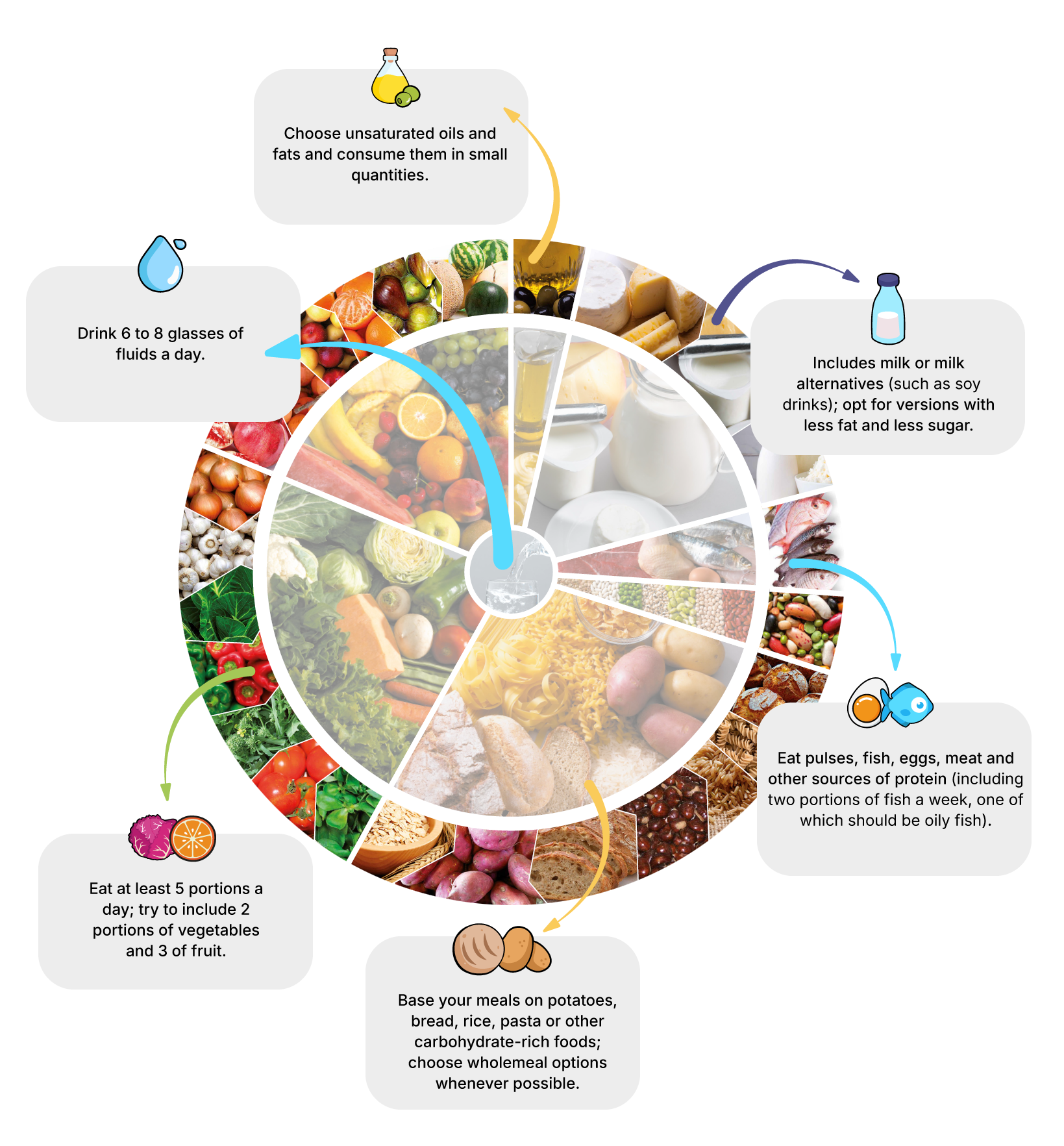
This is the Mediterranean Diet Wheel, specially adapted for you, based on the original model provided by the Directorate-General for Health. It presents, in a simple and visual way, the food groups that should form part of your diet, the recommended portion sizes, and the importance of variety and balance. Download it and put it somewhere visible to remind yourself to follow the principles of the Mediterranean Diet.
Draw your balanced meal
This document helps you put what you’ve learnt about healthy eating into practice by inviting you to draw your own balanced plate. The aim is for you to think about the ideal proportions of vegetables, fruit, protein and carbohydrates in a meal.
You can use colours and labels to make your dish look more realistic and appealing.
Download it, print it out and have fun creating healthy combinations.
EAT WELL, LIVE BETTER: 8 TIPS INSPIRED BY THE MEDITERRANEAN DIET
“Eating is about looking after your body, boosting your energy and safeguarding your health for the future.”
The Mediterranean Diet is much more than just a selection of foods; it is a healthy, sustainable and delicious way of life.
It is based on fresh, local and seasonal ingredients, shared around the table with family and friends.
These 8 tips will help you eat better every day, at school and at home.
1 - CHOOSE THE CARBOHYDRATES THAT ARE GOOD FOR YOU: WHOLEGRAIN, UNREFINED
Carbohydrates are the body’s fuel.
Opt for wholemeal or high-fibre options such as mixed-grain bread, brown rice, sweet potatoes, durum wheat pasta and pulses. In the Mediterranean diet, they are always served with vegetables and olive oil.
Did you know?Wholemeal cereals release energy more slowly and help with concentration.
FOODWISE Challenge:Make sure to include at least one wholefood in your next meal.
2 - FILL YOUR PLATE WITH FRUIT AND VEGETABLES
5 portions a day. One portion is what fits in the palm of your hand.
In the Mediterranean, fruit and vegetables feature in almost every meal: salads, soups and fresh fruit for dessert.
Did you know?The more colours on your plate, the greater the variety of nutrients.
FOODWISE Challenge:Make a ‘rainbow’ dish with at least three different colours.

3 - MAKE FISH A FRIEND TO YOUR HEART
Eat fish at least three times a week, including one portion of oily fish such as sardines, mackerel or salmon. It is a source of protein, omega-3 and vitamin D.
Did you know?Omega-3 helps protect the heart and brain.
FOODWISE Challenge:Swap the meat for fresh fish in one of this week’s meals.

4 - LESS BAD FAT, MORE GOOD FAT
Opt for unsaturated fats, such as olive oil, nuts and avocados, and limit your intake of saturated fats, such as butter and fatty meats. Extra virgin olive oil is the fat of choice in the Mediterranean diet.
Did you know?Swapping butter for olive oil helps to lower cholesterol.
FOODWISE Challenge:Use olive oil to season your sandwich.
5 - WATCH OUT FOR HIDDEN SALT AND SUGAR
Too much salt increases the risk of high blood pressure, and too much sugar can lead to tooth decay and weight gain.
In the Mediterranean diet, flavour comes from herbs and spices.
Did you know?Many sauces and cereals contain hidden sugar.
FOODWISE Challenge:Read the label on a product and see how much salt and sugar it contains.

6 - GET SOME EXERCISE EVERY DAY
Exercise is good for your health: play, walk, dance, cycle.
Young people: at least 60 minutes of physical activity a day.
Did you know?Just 10 minutes’ walk a day is good for your heart.
FOODWISE Challenge:Walk to school at least once a week.

7 - DRINK WATER, NATURE’S FUEL
Drink 6–8 glasses of water a day.
In summer, make the most of water-rich fruits such as watermelon and cantaloupe.
Did you know?Soft drinks don’t hydrate you like water does and are high in sugar.
FOODWISE Challenge:Swap a fizzy drink for flavoured water.
8 - NEVER SKIP BREAKFAST
A good breakfast gives you energy for the morning: wholemeal bread, fresh cheese, fruit and a glass of milk or natural yoghurt.
Did you know?People who eat breakfast have more energy for studying.
FOODWISE Challenge:Prepare your breakfast the night before.

FOODWISELab CHALLENGE

If you want to plan your meals effectively, start by recording everything you eat over the course of a week, identify where you can make improvements, and then plan the following week.
To do this, you can use the two worksheets – one to record the current week and the other to plan the next – both of which are available to download.
DOWNLOAD "MY FOOD DIARY" DOWNLOAD "MY MEAL PLAN"
Once you feel you’re already eating a balanced diet, you can start using this worksheet: