
Processamento do açúcar
Sugar is one of the most common ingredients in our diet, but its journey to our table is a long one, involving many stages of processing.
Sugar is extracted from two main plants: sugar cane, grown in tropical regions, and sugar beet, typical of colder climates, such as those found in Europe.
From the field to the factory
After harvesting, the sugar cane is cut at ground level and transported quickly to the factory, where processing begins.
In the case of sugar beet, the roots are pulled from the ground, washed and cut into thin strips called cossettes.
In the case of sugar cane, the stalks are crushed and pressed; in sugar beet, the cossettes undergo diffusion in hot water to extract the sugary juice, rich in sucrose, the main disaccharide used as table sugar.
Purification of the juice
The extracted juice contains natural impurities, such as fibre, proteins, minerals and other organic compounds.
To purify it, lime (calcium hydroxide) and carbon dioxide are added in a carbonation process, which causes the impurities to settle at the bottom of the tanks.
The clarified liquid is then heated and filtered, yielding a clear, thick syrup.
Sugar
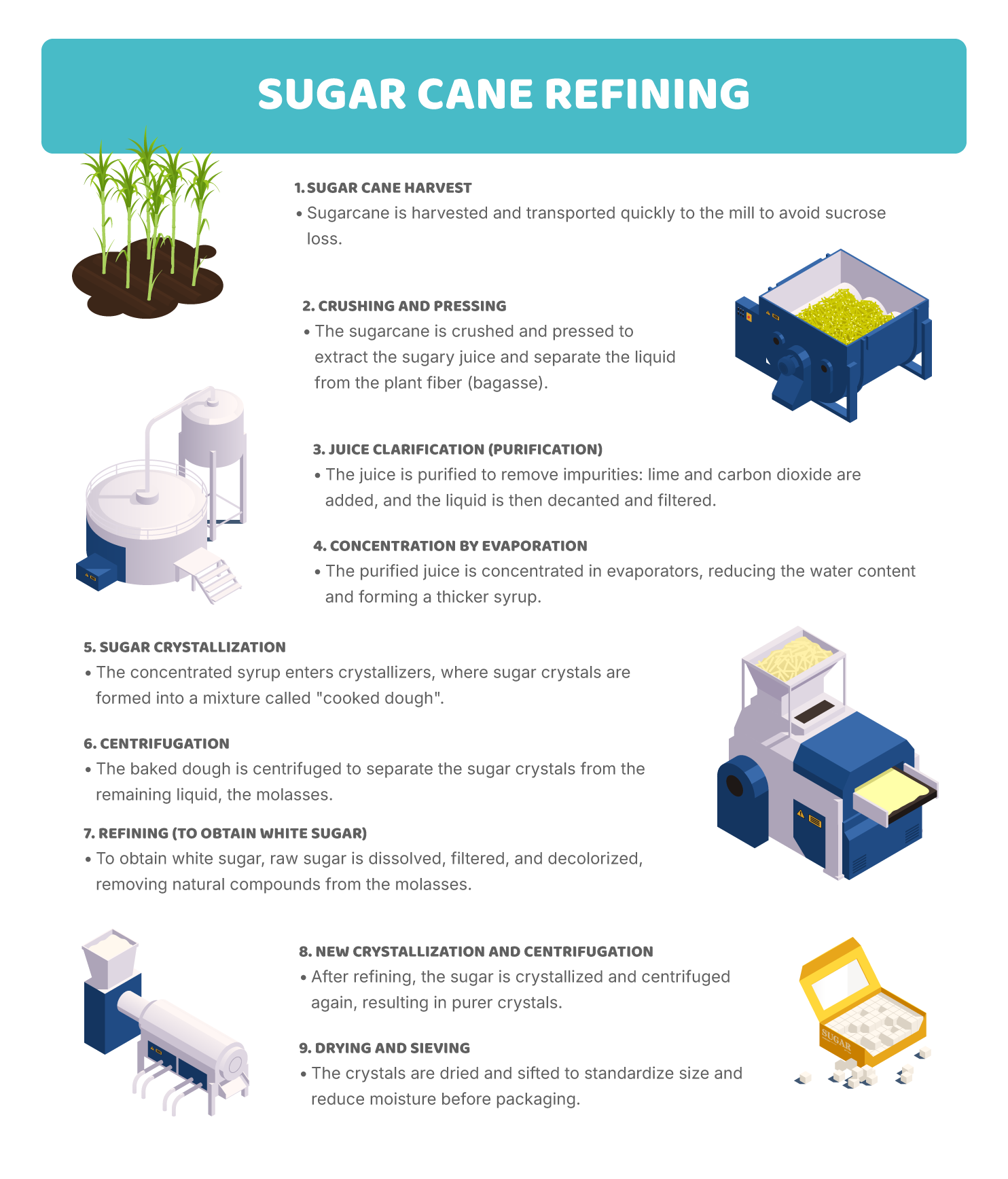
The syrup is concentrated through the evaporation of water in vacuum evaporators, reducing the temperature required for the water to evaporate.
As the liquid becomes denser, sugar crystals form.
This mixture of crystals and syrup, known as cooked mass, is placed in centrifuges which separate the solid sugar from the remaining syrup (the molasses).
The sugar is then washed, dried and sieved, ready to be packaged as raw sugar or to proceed to the refining stage.
Refining
To produce white sugar, raw sugar undergoes a refining process, which removes natural colourings and traces of molasses.
The end product is high-purity sucrose (around 99.8–99.9%), in the form of shiny white crystals.
Molasses and less refined sugars are used to make brown sugar, golden sugar or cane syrups, which retain small amounts of natural compounds derived from the molasses.
By-products and utilisation
Nothing is wasted in sugar processing:
- Sugarcane fibres (bagasse) are used as biofuel to generate electricity in factories;
- Beet pulp is mainly used as animal feed, but can also be used as a fertiliser;
- Molasses is used to produce ethanol, rum and yeast for baking.
These practices form part of the circular economy, which reduces waste and turns waste into new resources.
SUSTAINABILITY AND ENVIRONMENTAL IMPACT
Sugar production is water- and energy-intensive, particularly in tropical regions.
These days, factories are looking for more environmentally friendly solutions:
- Reuse of water used to wash the plants;
- Renewable energy production from sugarcane bagasse;
- More efficient use of fertilisers and pesticides;
- Certifications such as Bonsucro, which promote sustainable agricultural practices.

A tip for planning your meals
Sugar provides a quick energy boost, but should be consumed in moderation.
Opt for the natural sugars found in fruit and dairy products, and avoid foods containing added sugars, such as fizzy drinks, cakes and shop-bought sweets.
Reducing your sugar intake helps to protect your health and reduce the environmental impact of its production.
FOODWISELAB challenge

To understand how sugar is processed from its plant source to the final product, distinguishing between less processed sugars and more refined sugars, and to reflect on the impact of these choices on health.
From plant to sugar: How is sugar processed?